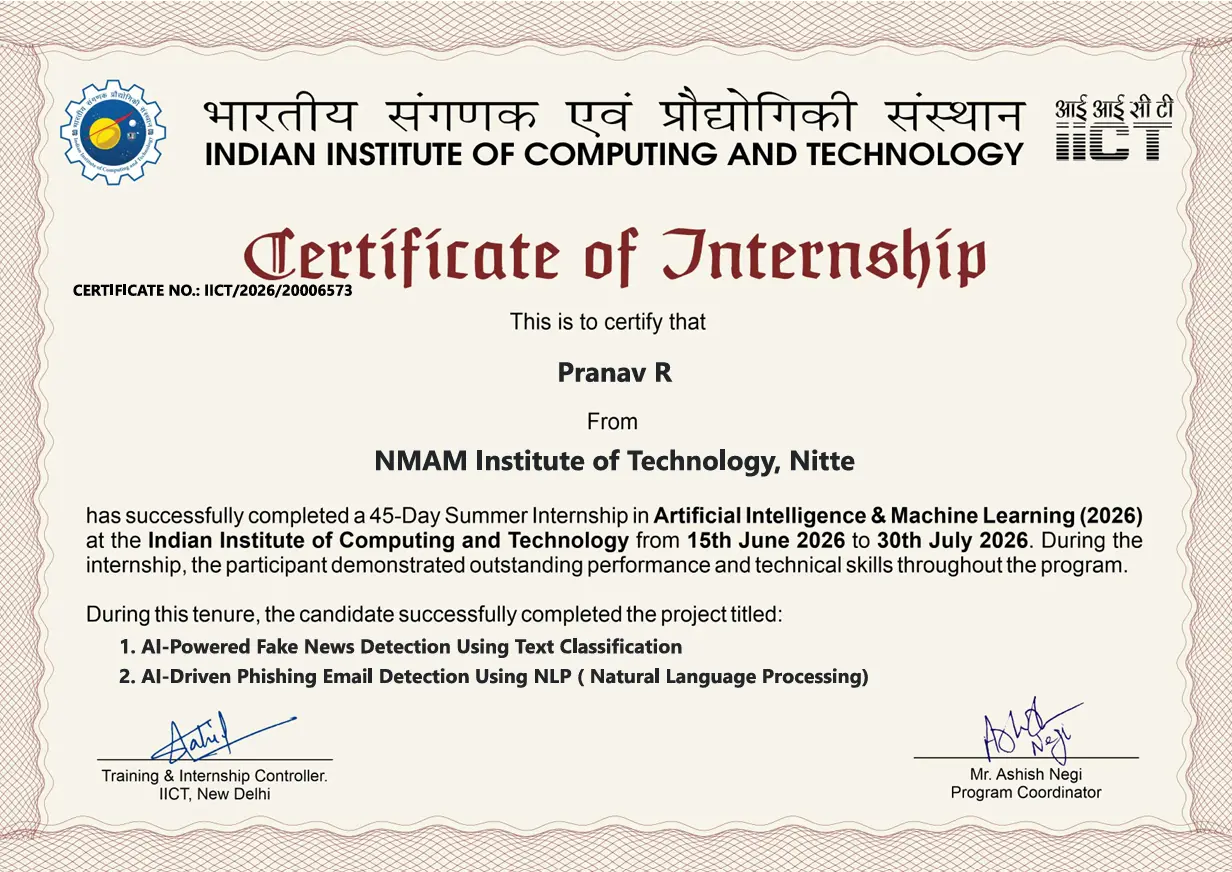
During the summer of 2026, I completed a rigorous 45-day online internship with the Indian Institute of Computing and Technology (IICT) focused heavily on Artificial Intelligence, Machine Learning, and Natural Language Processing (NLP).
Instead of just watching tutorials, the program was entirely project-driven. I had to build machine learning pipelines from scratch, handling everything from raw data collection to model evaluation. I decided to tackle two major cybersecurity issues using NLP: Fake News and Phishing Emails.
The Curriculum & Foundation
Before diving into the projects, the internship provided a deep, mathematical foundation in Machine Learning. We covered an extensive curriculum that bridged the gap between theory and real-world application. Some of the core modules I mastered included:
- Python for Data Science & Data Visualization: Using Pandas, Matplotlib, and Seaborn to understand hidden patterns in raw data.
- Statistics & Data Processing: The mathematical backbone of ML, including feature scaling, normalization, and handling missing data.
- Supervised & Unsupervised Learning: Understanding the difference between predictive modeling and clustering.
- Core Algorithms: I learned the inner workings of Linear & Logistic Regression, K-Nearest Neighbors (KNN), Decision Trees, and Random Forests.
- Deep Learning & Cybersecurity: Transitioning into Neural Networks and exploring how AI can be weaponized and defended against in modern cybersecurity.
With this foundation, I moved on to the core projects.
Here is a deep dive into what I built.
Project 1: AI-Powered Fake News Detection
With misinformation spreading like wildfire on social media, I wanted to build a system that could automatically flag fabricated articles.
The Process:
I used the ISOT Fake News dataset, which contains nearly 40,000 real and fake articles. Text data is incredibly messy, so I built a rigorous preprocessing pipeline to lowercase the text, strip punctuation, remove stop-words, and lemmatize the words.
To make the text understandable for the machine learning models, I converted the articles into a 5,000-dimensional sparse matrix using TF-IDF (Term Frequency-Inverse Document Frequency).
The Results:
I trained and tested several models, including K-Nearest Neighbors, Random Forest, and a Multi-Layer Perceptron (Neural Network). Interestingly, I found that Logistic Regression was the absolute sweet spot. It achieved a massive 99.02% accuracy in just 1.73 seconds of training time, completely outperforming the Neural Network which took over 5 minutes to train for similar results!
Project 2: Zero-Day Phishing Email Detection
For my second project, I focused on email security. Traditional spam filters rely on hardcoded rules, which hackers easily bypass. I wanted an AI that actually understood the linguistic tricks hackers use.
The Process:
Similar to the fake news project, I extracted linguistic features and structural patterns (like urgency keywords and HTML indicators) from a dataset of phishing and legitimate emails.
The Results:
Once again, after testing Naive Bayes and Random Forest, Logistic Regression proved to be the most balanced in terms of speed and accuracy. To make it actually usable, I didn't just leave it in a Jupyter Notebook, I deployed the final trained model into a live web application using Streamlit.
Key Takeaways
This internship was a huge turning point for me. It taught me that in the real world, the most complex model (like a deep neural network) isn't always the best choice. Sometimes, a highly optimized parametric model like Logistic Regression combined with excellent data preprocessing is all you need to achieve production-level accuracy.
Official Certifications
Below are my official certifications from the Indian Institute of Computing and Technology (IICT) recognizing my successful completion of the training and the 45-day internship.