
Project Overview
Understanding customer behavior is one of the most critical challenges in modern business. In this project, our team developed a predictive machine learning model designed to analyze historical marketing campaign data and forecast customer response patterns.
Beyond just writing code, a significant milestone of this project was the academic rigor involved. We prepared and submitted a formal research paper based on our findings, formatted to IEEE conference standards, giving me a profound introduction to the world of academic research and technical documentation.
Methodology & Workflow
- Exploratory Data Analysis (EDA): Visualized underlying trends, identified correlations between customer demographics and response rates, and mapped out data distributions.
- Data Preprocessing: Handled missing values, treated outliers, and encoded categorical features to prepare the dataset for algorithmic consumption.
- Model Training: Applied and compared foundational machine learning algorithms (such as Logistic Regression, Decision Trees, and Random Forest) to determine the best fit for our classification problem.
- Performance Evaluation: Utilized metrics like Accuracy, Precision, Recall, and the F1-Score to rigorously evaluate model reliability and mitigate false positives.
Team & Contributions

Pranav R
QA Tester & Research Co-Author- Conducted rigorous testing and evaluation of the machine learning models.
- Co-authored the research paper, strictly adhering to IEEE conference formatting guidelines.

P Suyash
Machine Learning EngineerCo-developed the main ML project, conducted extensive literature reviews, and contributed to the codebase.

Pratham (163)
QA Tester & Research Co-AuthorPerformed comprehensive model testing and contributed significantly to drafting the research paper.

Pratham Prabhakar
Lead Machine Learning EngineerDeveloped the core machine learning models, handled data preprocessing, and tuned classification algorithms.
Academic Context & Guidance
This project was made for the subject INTRODUCTION TO DATA SCIENCE (Course Code: IS1102-2), under the expert guidance of:

Mr. Sharath Kumar
Designation: Assistant Professor Gd.II
Institution: NMAM Institute of Technology (NMAMIT), Nitte
Email: sharath.sk@nitte.edu.in
Research & IEEE Paper Submission
Developing a predictive model was only half the journey. Translating complex code and data outputs into a structured, scientifically sound document was an entirely different challenge.
We structured our IEEE paper to clearly define the problem statement, review existing literature, explain our proposed methodology, and present our empirical results. This rigorous process taught me how to logically defend engineering decisions, format academic references properly, and communicate highly technical concepts to a broader research audience.
Conference Presentation & Recognition
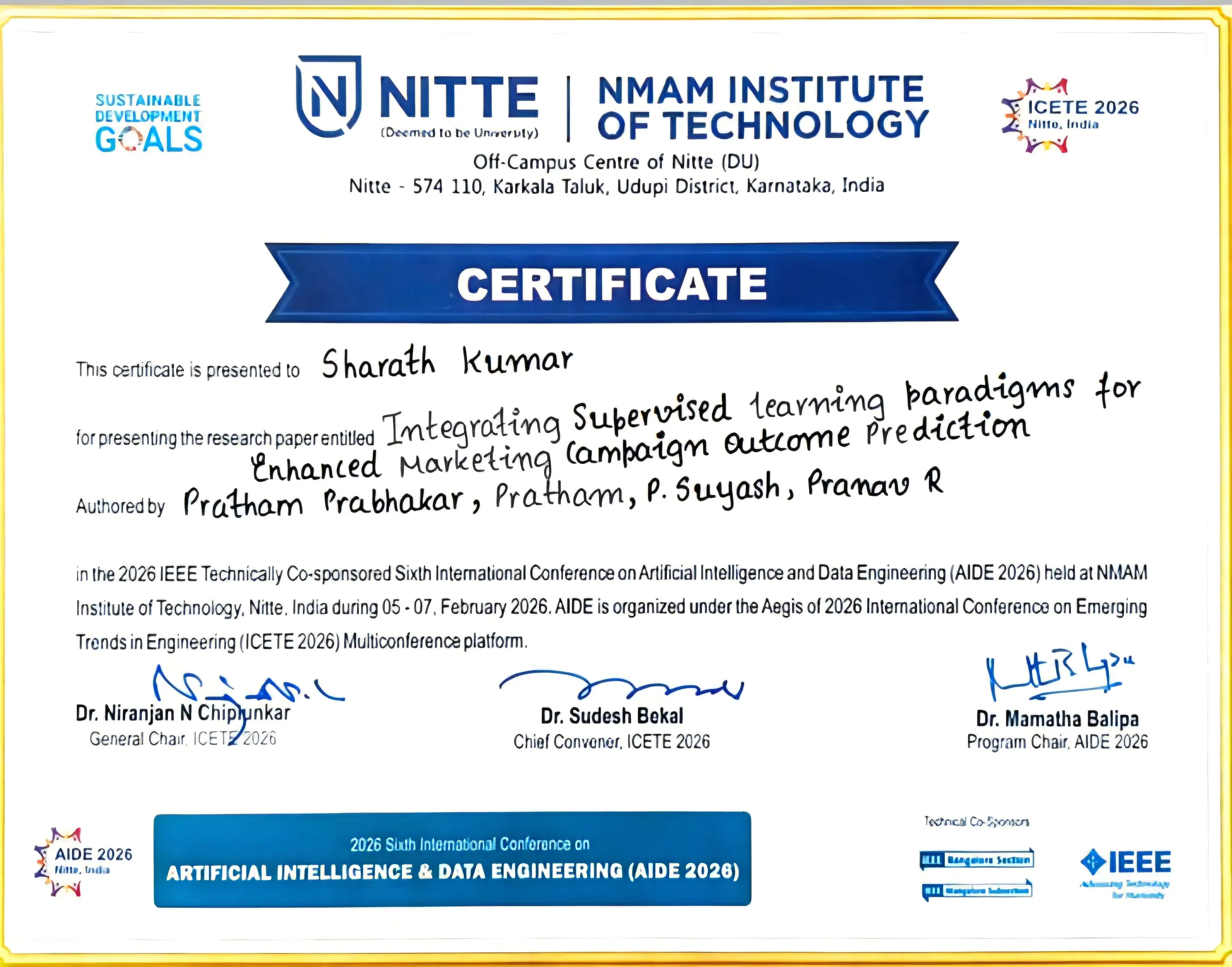
Our research paper, titled "Integrating Supervised learning paradigms for Enhanced Marketing Campaign Outcome Prediction", was successfully accepted and presented at an international IEEE conference by our guide, Mr. Sharath Kumar.
🏆 Certificate of Presentation
- Conference: 2026 IEEE Sixth International Conference on Artificial Intelligence and Data Engineering (AIDE 2026), under the aegis of ICETE 2026.
- Authors: Pratham Prabhakar, Pratham (163), P Suyash, and Pranav R.
- Presented By: Mr. Sharath Kumar
- Date & Location: February 05 - 07, 2026 at NMAM Institute of Technology, Nitte, India.
Impact & Learning Outcomes
This project was instrumental in shaping my understanding of data science. I learned that machine learning is not just about importing libraries; it is about deeply understanding the data, selecting the right metrics for the specific business context, and being able to formally document and present findings to the academic community.